HONEYBEES
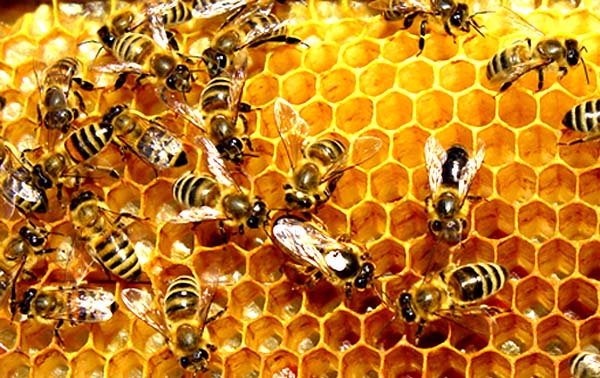
HONEYBEES (Apis mellifera) construct
their honeycombs with wax secreted from glands found on the underside of their
abdomen. The honeycomb is regarded as an engineering marvel. Why?
Consider : For centuries,
mathematicians suspected that partitions in the shape of hexagons were better
than equilateral triangles or squares —or any other shape—for maximizing space
with the least amount of building material. But they could not fully explain
why. In 1999, Professor Thomas C. Hales provided mathematical proof for the advantage of
what he termed “honeycomb conjecture.” He demonstrated that regular hexagons
are the best way to divide a space into equal parts with minimal structural
support.
By using hexagonal cells, bees can make the best use of all the
space available to them, produce a light but sturdy honeycomb with a minimum
amount of wax, and store the maximum amount of honey in a given space. Not
surprisingly, the honeycomb has been described as “an architectural masterpiece.”
Today, scientists mimic the bees’ honeycomb to create structures
that are both resilient and space efficient. Aircraft engineers, for example,
use panels patterned after the honeycomb to build planes that are stronger and
lighter and thus use less fuel.

Tidak ada komentar:
Posting Komentar